End-to-End vs. Hybrid AI Video Pipelines
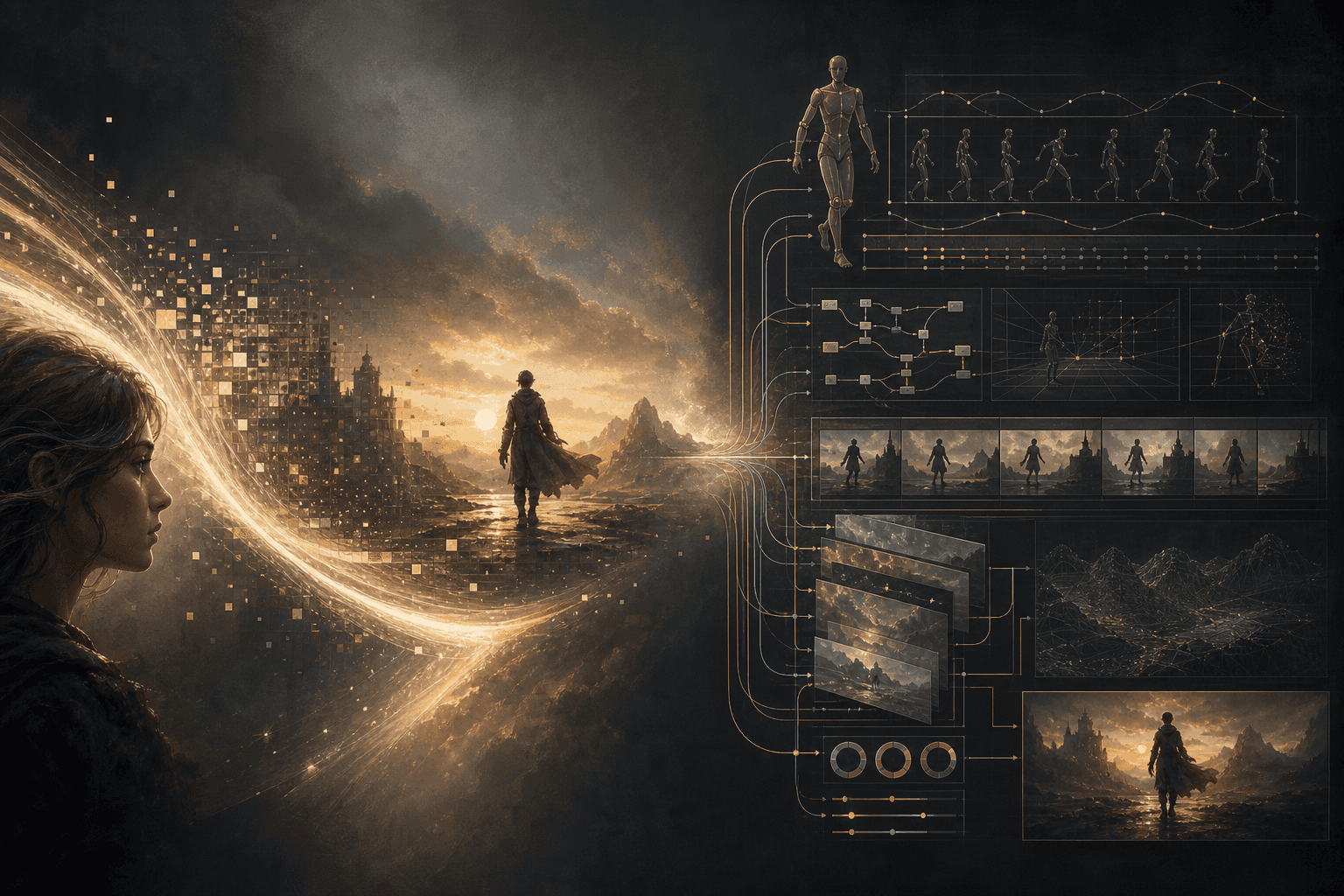
I divide AI video pipelines into two broad categories.
The key premise here is that we are specifically discussing video.
- End-to-end, pixel-based, AI-native pipelines
- AI-enhanced traditional pipelines, or hybrid pipelines
These are not simply two stages of the same roadmap. They begin with different beliefs about what an AI video production pipeline should be.
Two Different Beliefs
The philosophy behind an end-to-end pipeline is that the ultimate output of animation and video is pixels. If a system can directly produce the pixels we need, then we do not necessarily need 3D models, characters, rigs, keyframes, or many of the intermediate representations used in traditional production.
It does not attempt to improve the production pipeline. It questions why the pipeline needs to exist.
A hybrid pipeline begins from a different belief. The intermediate structure matters. Artists need representations they can inspect, control, exchange, and edit. AI should therefore participate in the existing production process rather than bypass it.
The distinction is not between an ambitious approach and a practical one. It is between two definitions of the problem.
The Nature of End-to-End Pipelines
End-to-end video generation is powerful precisely because it removes intermediate steps. That same property also defines its current limitations.
Limitations
Current models struggle when the target falls outside their training distribution:
- Custom or non-humanoid characters
- Exaggerated, non-linear poses such as stylized squash and stretch
- Highly abstract or non-standard physical actions
They are also stochastic and volatile. This makes them a poor fit for situations in which stakeholders expect strict predictability or guaranteed outcomes: a specific camera angle, complex lighting continuity, or exact animation behavior.
The issue is not that these outcomes are impossible. The issue is that they cannot always be promised before generation begins.
Best Use Cases
End-to-end generation performs best when the model's training distribution already aligns with the aesthetic goal:
- Realistic, cinematic, or fantasy-based live-action aesthetics
- Stop-motion simulation
- Textured, high-fidelity, or anime-inspired visual styles
- Story-forward content where the core narrative matters more than pixel-perfect precision
- Projects that can tolerate minor visual artifacts and resolve them through rapid iteration
Strategy
When animation quality becomes the weak point, shift the value proposition toward narrative, design, and world-building.
Strong ideas can survive imperfect motion. Animation-heavy, performance-driven styles are less forgiving. Classic 2D slapstick, for example, depends on deliberate timing, extreme poses, and expressive acting. If those are the main reasons the work succeeds, current end-to-end models are being tested at exactly their weakest point.
The Nature of the Hybrid Dilemma
The fundamental challenge of a hybrid pipeline is the lack of a shared data structure between human-editable workflows and AI-generated output.
Without that shared structure, collaboration between the artist and the model is limited.
Figma and code generation work because the AI produces editable formats. It can output HTML or source code, and a human can continue from there. The output remains part of the workflow.
Current image and video models produce something closer to a binary result: flat pixels. A human can evaluate those pixels, but cannot directly adjust the decisions that created them.
For animators, skeleton keyframes are not enough. A useful system would need to output the controllers and keyframes that an animator actually works with. Otherwise, the result still has to be translated back into a human-editable form.
Possible Bridges Between Humans and AI
There are several ways to approach this gap.
Translate the Data
We can transfer AI-generated animation into Maya, rebuild controls, perform manual cleanup, or use rotoscoping to recover editable information.
This works, but translation introduces its own cost. The value of the generated result depends on whether the time saved is greater than the time spent converting and cleaning it.
Standardize the Protocol
Human tools and AI models could communicate through a shared data structure such as USD.
In this model, AI output would not be an isolated result. It would be structured production data that can move between tools while preserving the information artists need.
Use AI as the Final Node
AI can also sit at the tail of the pipeline, after the last point where human editing is required.
This avoids the round trip. The traditional pipeline provides control upstream, and AI produces the final result only when no one needs to recover editable data from it. Motion in-betweening can work this way: it is efficient when generating the missing motion costs less than cleaning the output.
What Are We Actually Trying to Preserve?
The two pipeline philosophies can coexist, and both can become substantially more capable.
End-to-end models may gain stronger control, better consistency, and broader knowledge of unusual characters and motion. Hybrid systems may develop shared protocols, editable controller data, and much cheaper translation between AI output and traditional tools.
But solving every technical problem does not make the two approaches equivalent.
If the final goal is simply to get the pixels, then every intermediate representation must continue to justify why it exists. A perfect exchange format, an editable rig, or a lossless bridge between AI and Maya may solve the collaboration problem completely. None of them changes the original premise.
If the goal includes something beyond pixels—reusable assets, simulation data, interactive worlds, or control that has value independent of the final frame—then those structures have their own purpose.
The real question is not which pipeline works better today.
It is whether anything between intent and pixels still needs to exist.