Not Speed, but Continuity: The Real Bottleneck in AI Creative Production
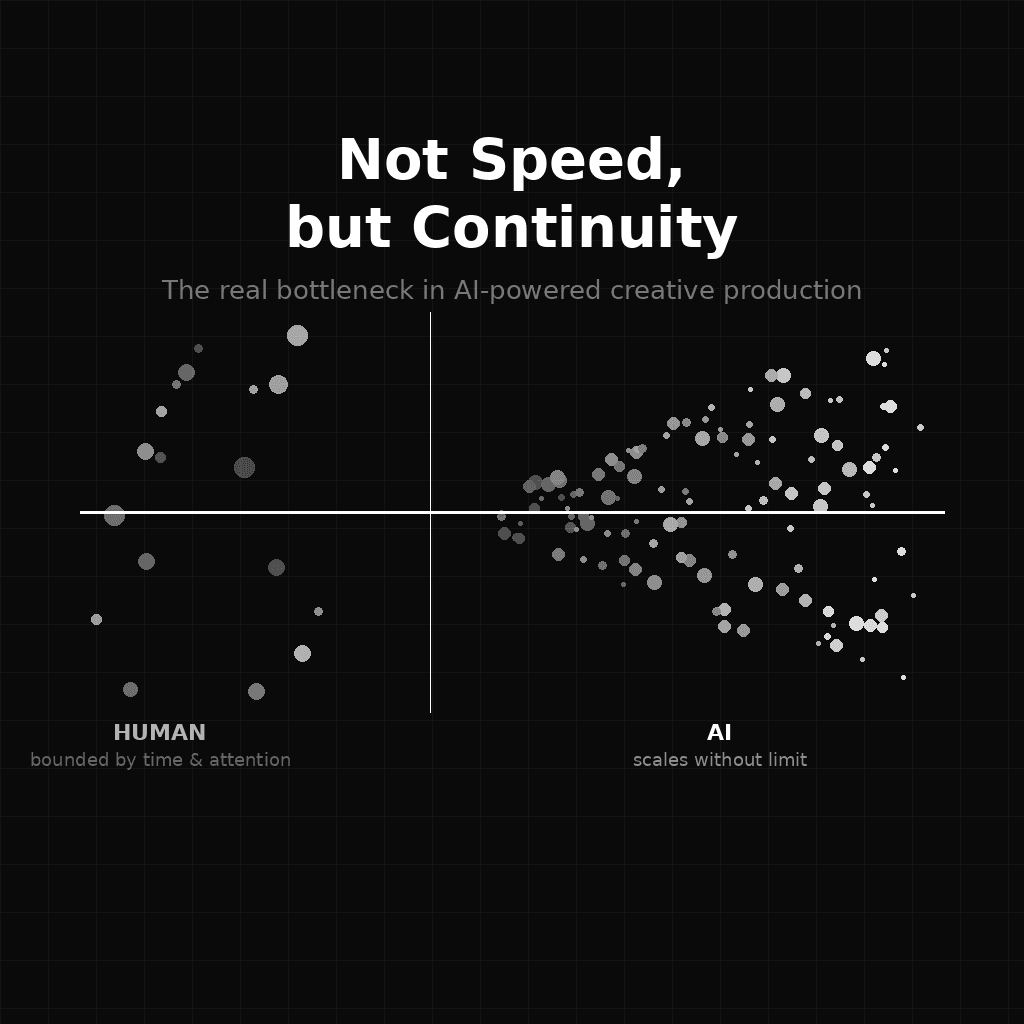
Everyone building AI tools is chasing the same thing: faster, cheaper, more controllable generation. It's a reasonable bet. It's also the wrong one.
The assumption is that if the model gets good enough — precise enough, fast enough, cheap enough — creative production will scale. Pour better tools into the pipeline and output multiplies.
But watch what actually happens when you sit down and try to make something.
The Iteration Wall
I can generate a near-perfect image on the first try. Maybe the second. By the fourth iteration, I'm still fixing the same detail — a character's hair, a composition problem, an ambiguous silhouette. By the thirtieth, I've lost the plot. Not because the tool failed. Because I did. My ability to judge whether iteration 31 is better than iteration 28 has collapsed. The signal is gone.
That's not a model problem. That's a human problem.
Here's what I know from my own production process:
- After roughly 30 iterations on a single piece, I lose judgment sensitivity
- After 8 hours, I need to stop entirely
- I can only work on one thing at a time
- If fixing something takes more than 4 retries, I'd rather just open Photoshop and paint over it manually
None of those limits change no matter how good the AI gets. They're not technological constraints. They're physical and cognitive ones.
The Market Is Chasing the Wrong Ceiling
Traditional creative tools — Photoshop, Premiere, Blender — have been refined for decades. From a working artist's perspective, AI generation is always compared directly against those tools. If the ceiling of existing tools sits at 95 out of 100, AI might be at 80 today. That gap matters enormously in professional workflows. But closing it from 80 to 95 is technically brutal and economically expensive. Short-term, the return on that chase is low.
Long-term, it doesn't scale at all. Even if generation cost reaches zero and the models become extraordinary — as long as a human is still required to operate, judge, and correct every output, total throughput is bounded by human time and attention. You cannot linearly scale a system whose bottleneck is a person.
The bottleneck is not the model. The bottleneck is the human.
The 80/20 of Creative Judgment
Here's what actually happens in a skilled creative review:
About 80% of the time, I'm running through a checklist. Does this break the 180-degree rule? Is the composition readable? Are there ambiguous silhouettes? Does the visual focus jump too far between shots? Is the subject properly guided by light or framing? These are rule-based evaluations. They have correct answers. They can be described, codified, and eventually checked programmatically.
The remaining 20% is genuine artistic preference — choices where there's no right or wrong, only taste.
The artistic part of creative judgment is smaller than people think. And it's shrinking as the tooling gets better, because better tools eliminate more of the obvious errors and push you faster into the territory where taste actually matters.
If 80% of review is rules, then 80% of the human review bottleneck is, in principle, automatable.
Volume Beats Perfection at Scale
Consider a simple thought experiment. Give the same script and the same production system to:
- One skilled human director
- Ten AI director agents, each with slightly different configurations and biases
The human probably produces a more refined and coherent result. But the AI team runs continuously and produces 20x the volume. Out of 20 variants, is it genuinely impossible that one matches or exceeds the human result? What about 100 variants? 1,000?
This is not the same as tool mastery, where years of expertise create a durable edge. Once you clear a threshold of commercial viability — let's call it "good enough" — incremental quality improvements become imperceptible to most audiences. For the majority of viewers, the difference between a 70 and a 90 is invisible. In that regime, volume wins. Consistency wins. The AI doesn't need to be perfect. It needs to be good enough, reliably, at scale.
And here's the asymmetry that matters: the rate of AI improvement is extremely fast. Human cognitive limits are fixed. They don't scale. They can't be multiplied.
The Real Strategic Direction: Scale Judgment, Not Generation
If the bottleneck is judgment, not generation, the strategic direction is clear.
Stop optimizing only for how fast you can produce. Start optimizing for how well — and how automatically — you can evaluate. The systems that win won't be the ones that generate the most. They'll be the ones that can judge, filter, and iterate without requiring a human in the loop for every decision.
But this raises a harder question: what kind of judgment, exactly?
The 80% — the rule-based checklist — is the easier part. Encode the rules, run the checks, automate the filter. That's engineering. The remaining 20% is something different. It's taste. The sense that a composition feels right even when nothing is technically wrong. The instinct that a shot lands emotionally before you can articulate why. This is what separates work that is correct from work that is alive.
Can AI Have Taste?
Most people assume the aesthetic part is irreproducible — that aesthetic sense is inherently human and therefore permanently out of reach for machines. I don't think that's true. I think it's learnable. Not by encoding more rules, but by training on the outcomes of taste: what gets chosen, what gets rejected, what resonates with real audiences at scale. Taste, at its core, is a pattern — a very complex, culturally loaded, contextually sensitive pattern, but a pattern nonetheless.
The agents worth building aren't just faster generators. They're agents that have developed a point of view. Agents that can look at their own output and know — not just check — whether it's working. That capacity, aesthetic judgment embedded in the loop, is what finally breaks the human bottleneck.
Scaling judgment is the problem worth solving. And the most important kind of judgment to scale is taste.