← work / line app / case study
減脂小豬
A LINE-native AI food diary — snap a meal, get a nutrition log in seconds.
- year
- 2026
- role
- Solo — product, design, engineering, operations
- platform
- LINE Official Account + LIFF
- stack
- LINE Messaging API, LIFF, Next.js, TypeScript, Supabase, OpenAI, Vercel
減脂小豬 ("the fat-loss piglet") is a food-diary product that lives entirely inside LINE. Users snap a photo of their lunch, the bot recognises the dish, estimates portions using Taiwan's six-food-group exchange system, asks for a one-tap confirmation, and replies with how much room is left for the rest of the day. No app download, no account sign-up, no manual calorie lookup.
This case study is a walkthrough of how it's built and why, written for teams who are thinking about building something on LINE themselves.
Why LINE instead of an app
In Taiwan, Japan and Thailand, LINE is where people already are. Asking someone to install yet another diet app is a big ask; asking them to add a LINE friend is not. That shapes every product decision:
- Zero install, zero sign-up. The LINE user ID is the account. Onboarding is "add friend → send first photo".
- Conversation is the UI. The fastest interaction is the one the user already knows: send a photo, tap a button.
- Push is native. Reminders and weekly reviews arrive in the same chat the user opens every day — no notification permission dialogs, no email.
The trade-off is that a chat window is a narrow canvas. Anything richer than a message — browsing history, editing an entry, charts — needs a different surface. That's where LIFF comes in.
What the user experiences
1. Photo → structured log in one round trip
- The user sends a food photo (or types
紀錄 拿鐵 224克). - The webhook sends the image to a vision model, which returns a structured breakdown: dish name, estimated grams, and servings per food group.
- The bot replies with a LINE Confirm Template: a short summary plus ✅ 儲存 / ❌ 取消 buttons.
- On ✅, the entry is saved and the bot replies with today's remaining allowance:
✅ 已儲存:雞腿便當

今日還能吃:
五穀雜糧  ▓▓░░░  剩 2.0 份
豆魚肉蛋  ▓░░░░  剩 9.0 份
蔬菜      ░░░░░  剩 6.0 份
油脂堅果  ░░░░░  剩 4.0 份
The confirm step matters. AI estimates are good but not perfect, and a user who sees a wrong number they didn't agree to stops trusting the product. A pending-then-confirm flow keeps the user in control while still being one tap.
2. A rich menu as the app's home screen
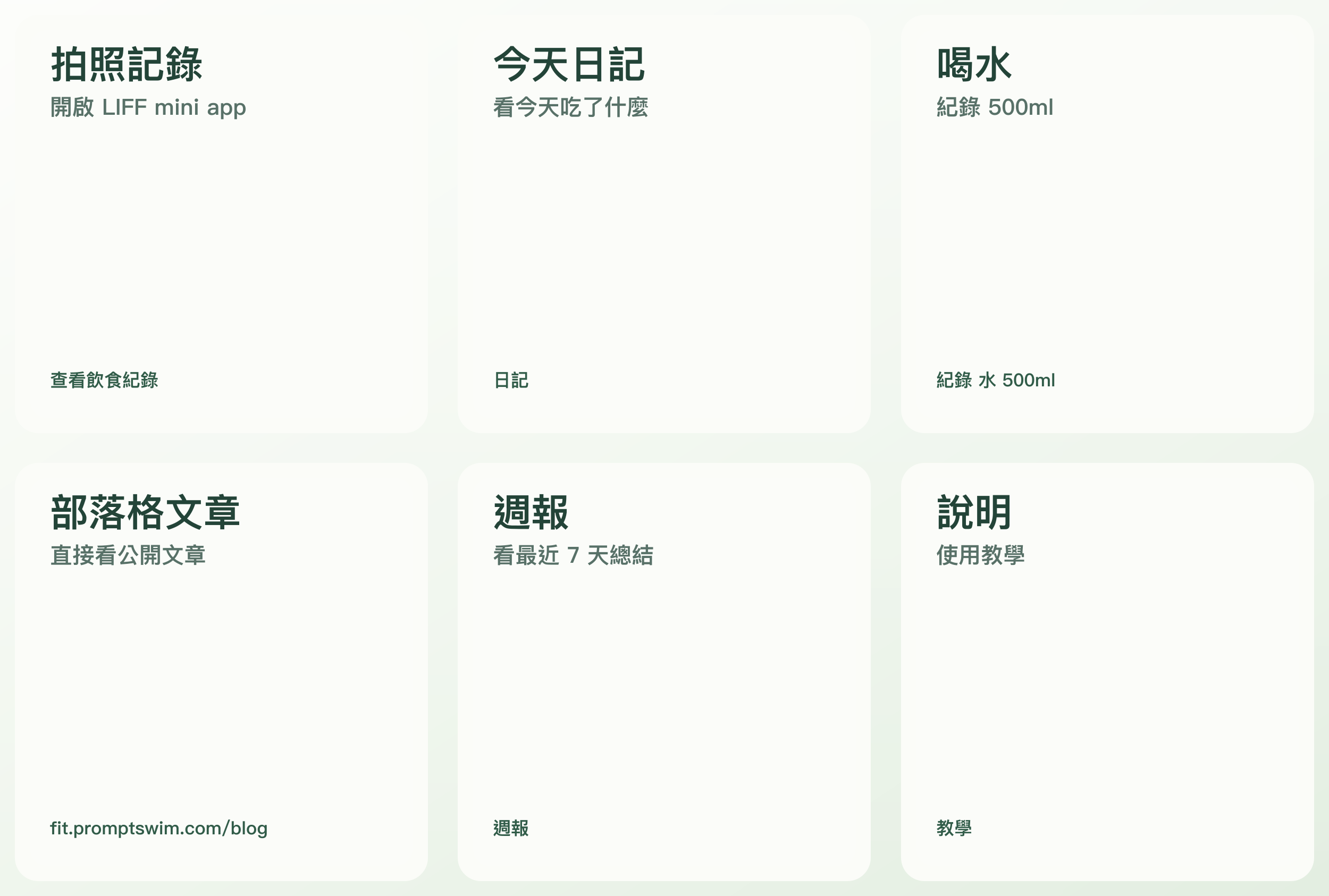
The rich menu is the persistent navigation bar at the bottom of the chat. It's generated from code (SVG → PNG), uploaded through the Messaging API and set as default with a single script, so changing the menu is a commit, not a manual console session.
3. A LIFF mini app for everything a chat can't do
Tapping 拍照記錄 opens a LIFF (LINE Front-end Framework) web app inside LINE. It's a regular Next.js page, but it runs with the user's LINE identity, so there's no login screen. It provides:
- A week view with per-day stats and food-group chips
- Editing and deleting entries
- Weight tracking with a trend chart
- Personal nutrition goals
It also quietly reports the device's time zone back to the server, so "today" means the user's today — a small thing that removes a whole class of off-by-one-day bugs for users travelling or living abroad.
4. Natural-language commands and an optional AI companion
Beyond photos, the bot understands plain Chinese: 日記 (today's summary), 週報 (7-day review), 我今天還可以吃什麼 (AI suggestion based on what's left today), 低脂那一份來自什麼 (which meal contributed that serving), 目標 蔬菜 5 (update goals). Users can opt into free-form AI chat with 跟我聊天 and turn it off with 閉嘴 — the bot never talks unless invited.
Architecture
LINE app
  └─► Messaging API
        └─► /api/line/webhook  (Next.js on Vercel, Tokyo)
              ├─ text     → command router / AI chat
              ├─ image    → vision parse → confirm card
              └─ postback → save or cancel → allowance reply

LIFF mini app ──► Next.js API routes
Cron jobs     ──► weekly review · re-engagement · D1 reminder

Everything reads and writes Supabase (Postgres + RLS).
- Next.js App Router serves the webhook, the LIFF app, the marketing landing page and an SEO blog from one codebase.
- Vercel, pinned to the Tokyo region to stay close to LINE's servers and Taiwanese users.
- Supabase Postgres, with a strict split between the public anon key (browser, protected by RLS) and the service-role key (server only). 16 numbered SQL migrations track the schema.
- OpenAI models, chosen per task: a stronger model for photos and corrections, a cheaper one for text logs. Every call goes through a single gateway function that records token usage per user, so cost per active user is a query, not a guess.
- Domain knowledge in code. Portion rules for the six food groups are encoded and verified after the model responds, rather than trusting the model to remember nutrition tables.
LINE-specific lessons
A few things that are easy to get wrong on LINE and that I'd bring to any client project:
- Reply tokens expire fast. The webhook must answer within seconds. Slow work (vision calls, database writes) has to be fast or structured so the user gets an immediate response.
- Push messages cost quota; reply messages don't. Design flows so most messages are replies to user actions, and reserve push for high-value moments (weekly review, a single re-engagement nudge).
- Don't nag. The re-engagement job nudges a user exactly once when they've been quiet for N days — never daily. Churned users who get spammed block the account, and blocks are permanent.
- Templates and quick replies beat free text. Buttons reduce typos, reduce AI cost, and make the bot feel like an app.
- Webhook signatures and secrets. Every request is verified against the channel secret; server-only keys never touch the client bundle.
Running it in production
Shipping the bot is half the job. Keeping it healthy as a solo developer required some automation:
- On-call alerting via LINE. Every uncaught server error is fingerprinted and deduplicated. The first sighting (and any regression) pushes an alert to my own LINE account.
- Agent-assisted fixes. A scheduled coding agent picks up new errors, investigates the repo, writes a fix, runs lint and tests, and opens a draft pull request for me to review. Humans still merge; the agent just shortens the time from error to fix.
- Funnel and retention reports. Events like first photo, first confirmation and return visits are logged so I can see where users drop off — which is how the re-engagement nudge and the improved onboarding message came about.
- CI on every PR. Lint plus a Vitest suite of 50+ test files, including time-frozen tests for anything that depends on "today".
- Content for acquisition. A blog of practical guides (eating at convenience stores, hotpot, night-shift meals, TDEE) drives search traffic into a LINE "add friend" CTA.
What this means if you need a LINE product
減脂小豬 is my own product, but the building blocks are the same ones most LINE projects need:
- Customers interact without installing an app → LINE Official Account + webhook bot
- Forms, dashboards, booking or editing screens inside LINE → LIFF mini app with LINE login built in
- A branded home screen in the chat → code-generated rich menu
- AI that understands photos or free text → vision + LLM pipeline with confirm-before-save
- Scheduled reminders and reports → cron-driven push with quota-aware rules
- Confidence it keeps running → error alerting, CI, usage tracking
Typical projects I can help with: membership and loyalty bots for shops and clinics, reservation and reminder flows, LIFF mini apps for order forms or customer dashboards, AI customer-service or intake bots, and integrating LINE with an existing backend.